
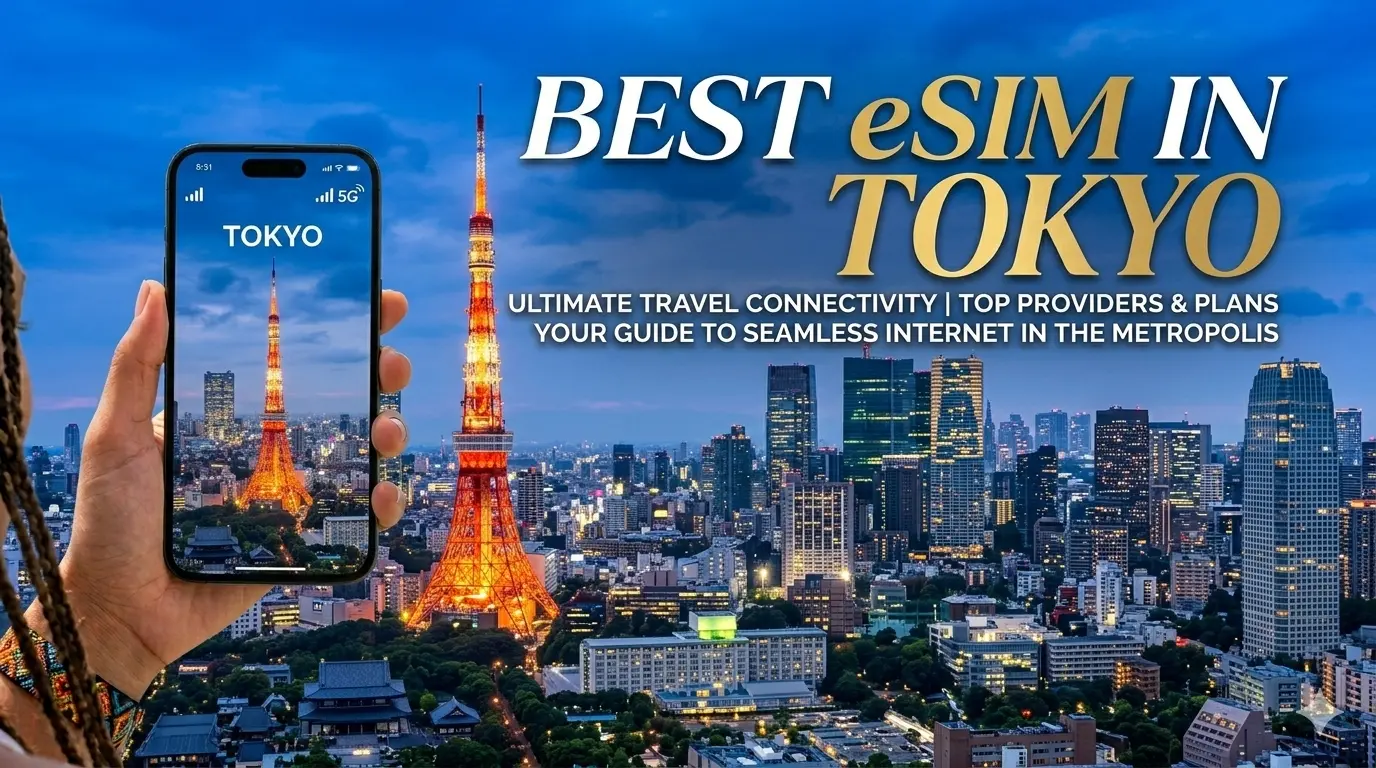
Best eSIM Providers in Tokyo
Tokyo's mobile network is, by most objective measures, among the best in the world. NTT Docomo, SoftBank, and au (KDDI) have built infrastructure that delivers 4G coverage in essentially every corner of the metropolitan area, including underground shopping malls, subway tunnels, multi-story buildings, and the dense residential neighborhoods that make up the bulk of the city's footprint.
5G is expanding aggressively in central wards, commercial districts, and transport hubs. For international visitors, this network quality is compelling but historically, accessing it has required navigating Japan's strict SIM registration requirements at airport counters with limited English support. Using an eSIM in Tokyo eliminates that barrier entirely.
This guide provides a detailed comparison of the best eSIM providers for Tokyo, with specific attention to Japan's unique connectivity characteristics, the specific data demands of Tokyo city travel, and which providers are best positioned to meet them.
Why Tokyo Is an Exceptional Destination for eSIM Travel
Japan has historically been one of the more complicated destinations for mobile connectivity. The country operates its own standards and has maintained registration requirements that create friction at the point of SIM card purchase. Airport SIM vending machines and rental counters at Narita and Haneda have long been the standard solution, but they involve queuing, limited plan options, and a physical SIM that requires handling the device's SIM tray.
The advent of international eSIM providers that route through Japanese carrier networks has changed this completely. You purchase a plan online before departure, scan the QR code when ready, and your phone connects to Docomo or SoftBank infrastructure as soon as it detects the Japanese network. No airport counter. No SIM tray tools. No registration paperwork.
For a first-time visitor arriving at Narita after a ten-hour flight, the ability to step off the plane and immediately have Google Maps working for the Narita Express into Shinjuku is genuinely significant.
Tokyo's network quality means that once you are connected, the experience is exceptional. Speed test data from Tokyo consistently ranks among the top global cities for average mobile download and upload speeds. Even in densely packed areas during peak hours such as Shibuya crossing, Shinjuku station during rush hour, major event venues network capacity holds up well due to Japan's infrastructure investment density.
VIA eSIM - Best eSIM for Tokyo
VIA eSIM is the top recommendation for Tokyo because it routes through NTT Docomo and SoftBank - the two carriers with the widest combined coverage footprint across the Greater Tokyo Metropolitan Area. Tokyo and Japan eSIM plans are activated before your flight so your connection is ready from the first moment you land at Narita or Haneda.
The practical value of VIA eSIM's Japan plans begins at the airport. Both Narita and Haneda are large, complex facilities where navigating between terminals, finding train connections, and locating bus stops requires real-time navigation. Having Google Maps working from the moment you exit the aircraft means the arrival logistics are manageable even for first-time visitors who have never navigated Japanese transport infrastructure before.
In-city performance with VIA eSIM's Docomo-routed plans is outstanding. All twenty-three central Tokyo wards are covered comprehensively. Coverage extends seamlessly into Greater Tokyo, including Yokohama, Kawasaki, Chiba, and Saitama.
Day trips from Tokyo to Nikko, Kamakura, Hakone, and the Fuji Five Lakes region are all within the Docomo network footprint. The Shinkansen corridor toward Osaka, Kyoto, and Hiroshima maintains coverage along the route, making VIA eSIM equally useful if your itinerary extends beyond Tokyo into Kansai.
VIA eSIM's plans include hotspot sharing, which is particularly valuable in Tokyo for travelers who want to use a laptop in their Airbnb or capsule hotel without relying on building WiFi. Japan's accommodation WiFi quality varies significantly, and having a mobile hotspot as a reliable backup is a meaningful comfort for remote workers and content creators.
How VIA eSIM Compares to Other Providers
IIJmio — IIJmio is a Japan-based MVNO that offers eSIM plans specifically designed for the Japanese market, including options for international visitors. IIJmio's plans run on Docomo's network and provide genuinely solid coverage with the reliability of a Japan-native operator. The trade-off is setup complexity: IIJmio's activation process involves online account creation, and some plan configurations require a Japanese payment method. For longer stays in Japan - several weeks or more - IIJmio's deeper local market positioning can deliver better value per gigabyte on large data plans. For a standard two-week Tokyo visit, VIA eSIM's simpler international-friendly setup is the more practical choice.
Airalo — Airalo's Japan plans are a popular choice for budget-conscious travelers and first-time eSIM users who value the familiarity of a widely reviewed platform. The Tokyo plans work adequately through partner network arrangements, and for light usage - transit navigation, messaging, and occasional content uploads - Airalo provides sufficient coverage.
For heavy data users, remote workers, or travelers who want the most consistent speeds during peak hours in high-density areas like Shibuya, Harajuku, or Akihabara, VIA eSIM's direct carrier routing delivers noticeably more reliable performance. Before purchasing any Japan eSIM, it is also worth confirming your phone's eSIM compatibility because some older iPhone models sold in Japan were originally released without eSIM support, and regional variants can differ from global models.
MobiMatter — MobiMatter offers flexible plan sizing that suits travelers combining Tokyo with other Asian destinations. If your itinerary includes Tokyo, Seoul, Taipei, or Singapore across a single extended trip, MobiMatter's app-based management makes it more straightforward to handle multiple country eSIM plans through a single interface. For Tokyo-only visits, VIA eSIM's Japan-optimized plans represent better value.
Holafly — Holafly's unlimited data plans are a strong match for Tokyo travel given the high data demands of the city - particularly for travelers using Google Translate's camera function constantly, navigating complex transit interchanges in real time, and uploading photo and video content throughout the day. An unlimited plan removes the calculation from every data action, which significantly reduces friction in a city as rich and stimulating as Tokyo.
Coverage on Holafly's Japan partner network performs reliably across central Tokyo wards. For travelers who find data rationing stressful in an unfamiliar city where every navigation decision requires connectivity, Holafly's unlimited structure is a meaningful quality-of-life improvement.
Ubigi — Ubigi's Japan plans provide reliable Tokyo coverage with the added advantage of in-app plan extension and top-up functionality that suits travelers whose Japan itineraries are unpredictable in length. If a side trip to Kyoto, Hiroshima, or Hokkaido extends your stay or consumes more data than anticipated, Ubigi's top-up process is quick and does not require purchasing a new QR code.
Coverage through Ubigi's Japan carrier partnerships is solid across Tokyo and the major Shinkansen corridors. For business travelers who may extend their Japan trip at short notice, Ubigi's flexibility is a practical advantage over fixed-term plans.
Nomad — Nomad is a well-regarded option for Japan eSIM coverage with competitive tiered data pricing and a strong reputation for activation reliability. The platform is particularly well-suited to first-time Japan visitors who want a trusted, widely reviewed provider without navigating the complexity of Japan-specific operators like IIJmio.
Coverage in Tokyo across all central wards is reliable. Nomad's Asia-wide plans are worth evaluating if your trip includes both Japan and other countries in the region, as the bundled coverage can offer better value than purchasing individual country plans separately.
What Tokyo Travelers Need From a Data Connection
Tokyo imposes specific demands on mobile data that differ from European or North American city travel. The transit network is genuinely complex, and Google Maps navigation through the combination of JR lines, private rail, Tokyo Metro, and Toei Subway requires continuous GPS and data connectivity. Offline maps help but do not fully replace real-time route adjustment when trains are delayed or when navigating multi-level station interchanges for the first time.
Google Translate's camera function is heavily used by non-Japanese speakers in Tokyo, consuming meaningful amounts of data throughout a day of exploring neighborhoods, reading menus, and navigating signs in areas less oriented toward English speakers. This is one of the genuinely transformative mobile tools for Tokyo travel, but it requires a live data connection to function at full capability.
Content creation demands in Tokyo are high. The city offers exceptional photography opportunities across an enormous range of environments - temple gardens, neon-lit streets, food markets, gaming arcades, cherry blossom parks - and uploading content in real time or backing up to cloud storage consumes significantly more data than basic navigation and messaging.
FAQ - eSIMs in Tokyo
Does an eSIM work on the Tokyo Metro?
Yes. Japan has invested heavily in underground mobile coverage, and the Tokyo Metro has signal on most lines including in tunnels. Coverage is more consistent than many major world cities. You can navigate, message, and browse throughout most subway journeys without signal dropping.
Can I use a Japan eSIM outside Tokyo?
Yes. VIA eSIM's Japan plans cover the entire country on Docomo's national network. Osaka, Kyoto, Hiroshima, Nagoya, Sapporo, Fukuoka, and the Shinkansen corridors connecting them are all within coverage. The same plan you use in Tokyo works everywhere else in Japan.
Will a Japan eSIM work at Tokyo Disneyland?
Yes. Tokyo Disneyland and DisneySea are located in Urayasu, Chiba, approximately thirty minutes from central Tokyo, and have strong coverage throughout both parks.
Is it worth getting a Japan eSIM versus renting a pocket WiFi?
For solo travelers, an eSIM is almost always the better choice - lower cost, no device to carry and return, and no battery dependence on a second device. For families or groups of three or more who all need connectivity, pocket WiFi can offer better per-person value. For digital nomads or remote workers who need a laptop connection, an eSIM with hotspot permissions is usually more reliable and simpler than pocket WiFi rental logistics.
Do I need a Japanese phone number for using services in Tokyo?
Most international visitors do not. Restaurant reservations can be made through apps like TableAll or Tablecheck in English. Major services accept international contact information. The only common scenario where a local Japanese number is useful is for receiving OTP messages on Japanese banking apps or registering for certain local services during extended stays.