
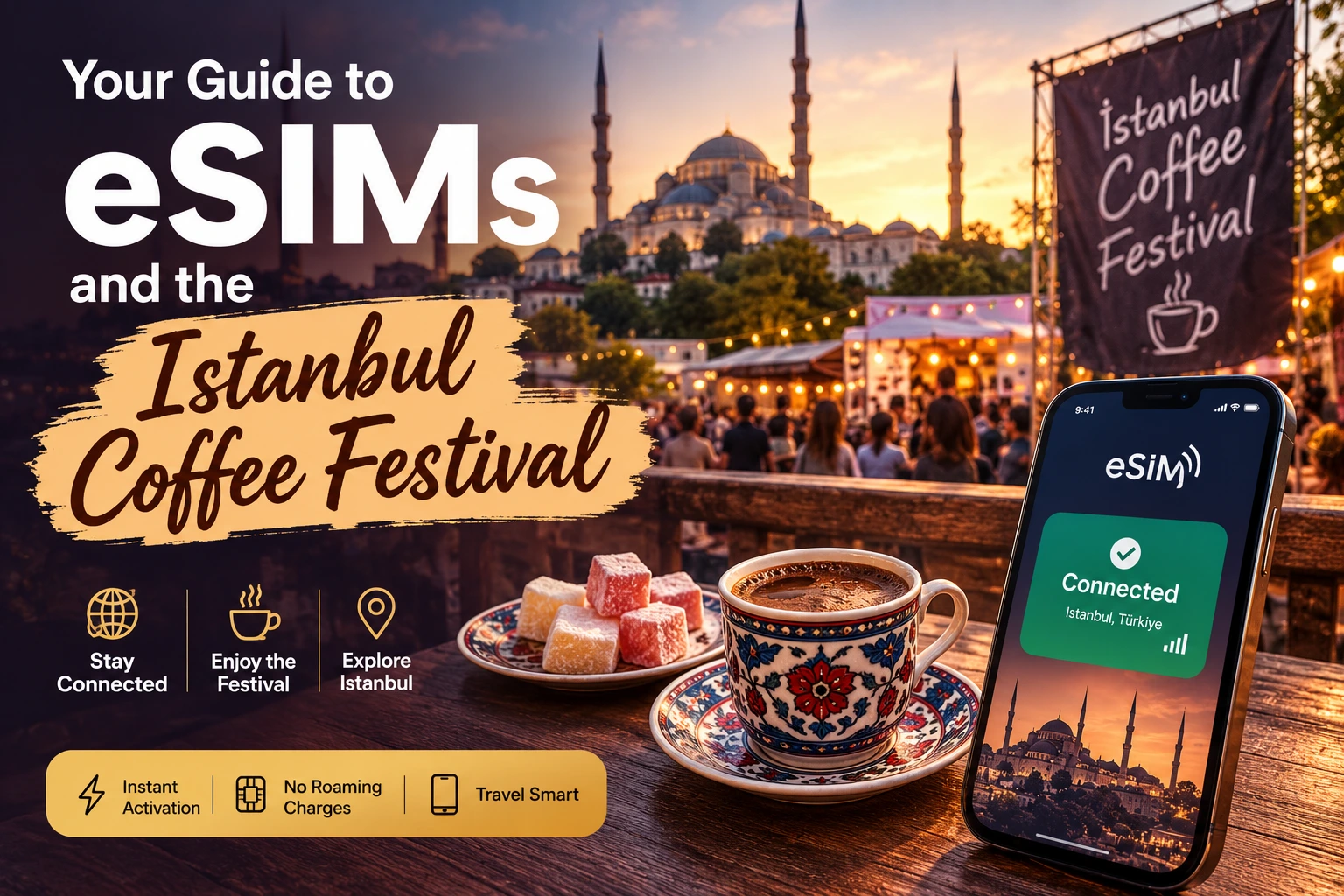
Your Guide to eSIMs and the Istanbul Coffee Festival
Istanbul is a city where a phone stops being a convenience and becomes a necessity. It spans two continents. It has a public transport system that mixes trams, metros, funiculars and ferries. Its street layout in the older districts was designed centuries before anyone thought about grid systems. Getting lost is part of the experience, right up until the moment you actually need to be somewhere.
Add a four day festival spread across venues, and reliable mobile data moves from useful to essential.
An eSIM for Turkey solves this before you land. You get working data at Istanbul Airport, with no roaming charges, no shop visit, and importantly no phone registration process.
That last point deserves attention, because Turkey has a rule that catches travelers out more than almost anywhere else. We will get to it.
This guide covers the Istanbul Coffee Festival running 10 to 13 September 2026: getting online, how much data you need, getting around the city, network performance in crowds, and what else to see while you are there.
The Turkey Phone Registration Rule You Need to Know About
This is the single most important thing in this guide for anyone considering a local SIM.
Turkey operates a device registration system. If you use a Turkish SIM card in a foreign phone, that phone's IMEI number gets registered. After a limited period, typically around 120 days, an unregistered foreign device stops working on Turkish networks entirely. To keep using it you have to pay a registration fee, which is not small.
For a short trip this usually does not bite. But travelers who visit Turkey repeatedly, or who stay longer, regularly discover their phone has been blocked. Diaspora travelers and frequent visitors get caught by this most often.
An eSIM avoids the issue in a way people find genuinely useful. You are connecting through a travel data profile rather than putting a Turkish operator's SIM into your device, so you are not starting that registration clock in the same way.
There is a second, simpler benefit. Buying a local SIM in Turkey requires your passport and a registration process at the shop. An eSIM requires nothing but a QR code.
If you are weighing the options, our comparison of whether an eSIM or physical SIM is right for you goes through the trade-offs in more detail.
What Roaming in Turkey Actually Costs
Turkey is not in the European Union. EU Roam Like At Home rules do not apply here.
That means EU travelers, who are used to their domestic allowance working across the continent, are on international roaming rates the moment they land. The European Commission's roaming framework covers EU and EEA member states only, and countries outside that group are governed by individual operator agreements. [Source: ec.europa.eu]
Some carriers include Turkey in an extended roaming zone. Many charge daily rates that add up quickly across a four day festival trip. And travelers from the UK, United States, Canada, Australia and the Gulf are almost always on standard international rates.
The other issue is throttling. Even where roaming is technically included, fair use caps often mean your speed drops sharply after a small allowance. You have a connection, but it is too slow to be useful for maps in a crowded district.
A travel eSIM gives you a fixed price and full speed for a known amount of data. No bill waiting when you get home.
What an eSIM is, Simply
An eSIM is a SIM card that lives in your phone as software instead of as a physical chip. You buy a plan, get a QR code, scan it, and the profile downloads.
Your regular SIM stays exactly where it is. Your usual number keeps working for calls and texts. The eSIM handles data only. You are not replacing anything.
Phone Compatibility
Most phones from recent years support eSIM:
- iPhone: XS, XR and all newer models
- Samsung Galaxy: S20 and newer, plus recent Z Fold and Z Flip
- Google Pixel: Pixel 3 and newer
- Others: Many recent Sony, Motorola, Oppo, Xiaomi and Huawei models
Two checks before buying. Your phone must be carrier unlocked, since contract phones are sometimes network locked. And if you travel frequently you may have old profiles stored. It is worth knowing how many eSIMs you can have on one phone so you can remove unused ones first.
Set It Up Before You Leave
Install your eSIM at home, on wifi, before you fly. This is the advice that saves the most hassle.
You need internet to download an eSIM profile. Istanbul Airport is enormous and its wifi is usually fine, but after a long flight, in a queue at passport control, is not when you want to be troubleshooting a download.
The steps:
- Buy your plan and receive a QR code by email.
- Open phone settings, go to mobile or cellular data.
- Select add eSIM or add data plan.
- Scan the QR code.
- Name it something clear, like "Istanbul September".
- Leave it switched off until you land.
Keep it off until arrival because most travel plans start counting from first activation rather than from purchase.
When you land, switch it on in settings and you have data before you reach the taxi rank. If you want a step by step version, see our guide on how to set up your VIA eSIM.
How Much Data for an Istanbul Trip?
Istanbul is a navigation-heavy city. You will use maps constantly, more than in most destinations, simply because the geography is complicated and the older districts are a maze.
Here is what common activities use:
Activity Approximate data use Maps navigation 5 MB per hour WhatsApp messages and photos 10 MB per hour Instagram scrolling 100 MB per hour Uploading a 60 second video 50 to 100 MB Music streaming 80 MB per hour Video streaming, standard quality 700 MB per hour Video call home 300 MB per hour Translation apps with camera 20 MB per hour That last row matters here. Live camera translation for menus and signs is genuinely useful in Istanbul and it uses more data than people expect.
Planning guidance:
- Festival weekend, four days: 5 GB
- A week in Istanbul: 10 GB
- Two weeks or heavy video posting: 20 GB or unlimited
Download offline maps for Istanbul before you travel. The city is large enough that offline maps save a meaningful amount of data across a week, and they work in the metro where signal drops.
Getting Around Istanbul
From the airport. Istanbul Airport (IST) is on the European side, around 40 kilometres from the centre. The M11 metro connects it to the city. Havaist buses run to major districts. Taxis work but traffic can make the journey long and expensive at peak times. Sabiha Gökçen (SAW) on the Asian side serves many budget carriers and is further from the historic centre.
Istanbulkart. Buy one immediately. It is a rechargeable travel card that works on metro, tram, bus, funicular, ferry and Marmaray. You can buy it at machines in stations and airports. Everything is cheaper with it and some services do not accept anything else.
The ferry. Do not treat it as just transport. The commuter ferries across the Bosphorus between the European and Asian sides are one of the best things about the city and they cost the same as a metro ride.
Metro and tram. Clean, efficient and expanding. The T1 tram covers most of the historic sights on the European side. Signal in tunnels is patchy, which is another reason for offline maps.
Taxis and rideshare. Yellow taxis are metered. Insist the meter is running. BiTaksi and Uber both operate and both reduce the friction considerably.
Walking. The historic peninsula is walkable, but Istanbul is hilly. More than visitors expect. Wear proper shoes.
A practical note. The city is genuinely split across two continents and crossing takes time. Check which side your festival venue and your hotel are on before you book. A short distance on a map can be an hour in traffic.
Does Mobile Data Hold Up in Istanbul Crowds?
Istanbul is one of the most visited cities in the world and September is a strong season for it. Combine that with a festival and you get real network load.
Crowds strain mobile networks anywhere. Thousands of phones in one venue all uploading at once will congest local cell capacity, which is why you can see full bars and still have nothing load.
Turkey's network infrastructure is well developed, with high 4G population coverage and 5G expanding in major cities. The ITU publishes global data on mobile network coverage and its figures show strong high-speed mobile availability across Turkey's urban centres. [Source: itu.int] What varies at a busy event is capacity on the night, not coverage on paper.
This is exactly what VIA eSIM is tested against. VIA eSIM plans have been tested in some of the most demanding real-world conditions, including Old Trafford stadium with 75,000 people present, where data worked flawlessly, averaging 250 Mbps on 5G.
We have also tested VIA eSIM across Istanbul. We recorded 330 Mbps on 5G near Hagia Sophia in Sultanahmet with heavy tourist crowds, 295 Mbps on 4G inside the Grand Bazaar, and 310 Mbps on 5G on İstiklal Street during a busy evening. The Grand Bazaar result is a useful one, since indoor covered markets are a common dead spot for mobile signal.
Crowd tips regardless of provider:
- Agree a specific meeting point with your group before you separate.
- Send messages instead of calling. Text uses a fraction of the bandwidth.
- Screenshot tickets, addresses and booking confirmations before you go out.
- Carry a power bank. Maps plus camera plus searching for signal empties a battery fast.
- Save your hotel address in Turkish. It makes taxi journeys much easier.
Sharing Your Connection
Hotspot and tethering let you share your data with travel companions or a laptop. On a city trip where one person is doing the navigating anyway, this works well.
Switch on personal hotspot in settings, set a password, and others connect like they would to wifi.
Two cautions. Hotspot use drains battery quickly. And shared data disappears faster than you expect, especially if someone streams video. If you are covering a group, buy a larger plan.
What Else to Do in Istanbul
September is arguably the best month to visit. The summer heat has eased, the light is good, and the crowds are lighter than July and August.
The essentials. Hagia Sophia, the Blue Mosque, Topkapı Palace and the Basilica Cistern are all within walking distance of each other in Sultanahmet. Go early. By mid-morning the queues are substantial.
Markets. The Grand Bazaar is the famous one, with thousands of shops under one roof. The Spice Bazaar is smaller and more focused. Both involve bargaining, which is expected rather than rude.
Coffee culture. Given the festival, this is the trip to take Turkish coffee seriously. It is UNESCO listed as intangible cultural heritage. Order it sade for no sugar, az şekerli for a little, or orta for medium. Let the grounds settle before you drink.
The Asian side. Kadıköy and Moda are where the city feels most lived-in rather than visited. The food scene is excellent and the prices are better. Take the ferry across.
Bosphorus cruise. Worth doing once. The public ferry up the Bosphorus is far cheaper than the tourist boats and shows you the same waterfront.
Practical notes for Turkey:
- The currency is the Turkish lira. Cards are widely accepted in Istanbul, but carry cash for markets, small cafés and taxis.
- Exchange rates vary considerably between exchange offices. Compare a couple before changing a large amount.
- Tipping is customary at around 10 percent in restaurants.
- Dress modestly when visiting mosques. Women should cover their heads, and scarves are usually available at the entrance. Shoes come off.
- Mosques close to visitors during prayer times. Check before you plan a visit.
- Tap water is generally not drunk. Bottled water is cheap and everywhere.
Frequently Asked Questions
Q: Will using an eSIM trigger Turkey's phone registration rule? A: Using a travel data eSIM is different from putting a Turkish operator's SIM card into your phone, which is what starts the registration process. For short visits this is not usually a concern either way, but frequent visitors to Turkey often prefer the eSIM route for this reason. If you are staying long term, check current regulations, as they can change.
Q: Can I keep my normal phone number? A: Yes. Your physical SIM stays active for calls and texts on your usual number. The eSIM handles data only.
Q: Do I need my passport to get an eSIM? A: No. That requirement applies to buying a local physical SIM in Turkey. An eSIM needs no documentation.
Q: Does data work on the Istanbul metro? A: Coverage in stations is generally good. Tunnel sections can drop. Download offline maps.
Q: How much data do I need for four days? A: Around 5 GB covers a festival weekend with normal use, maps and social posting. Go higher if you plan to upload a lot of video.
Final Thoughts
Istanbul is a city that rewards wandering, and wandering is much easier when you can find your way back. Between two continents, a complicated transport network and a festival spread across venues, working mobile data is what holds a trip like this together.
An eSIM for Turkey handles it before you leave home. No roaming charges, no passport at a shop counter, and none of the device registration friction that comes with a local SIM.
Plan for around 5 GB for the festival weekend and 10 GB for a full week. Download offline maps for the city. Buy an Istanbulkart on arrival. Save your hotel address in Turkish. Carry a power bank.
VIA eSIM plans are tested in exactly these conditions, from capacity stadiums to the covered halls of the Grand Bazaar. Have a look at the Turkey plans and get set up before you fly.
Sources
- European Commission, Roaming regulation, scope of Roam Like At Home across EU and EEA states. https://ec.europa.eu/digital-single-market/en/roaming
- ITU (International Telecommunication Union), Facts and Figures, global mobile network coverage and performance data. https://www.itu.int/itu-d/reports/statistics/