
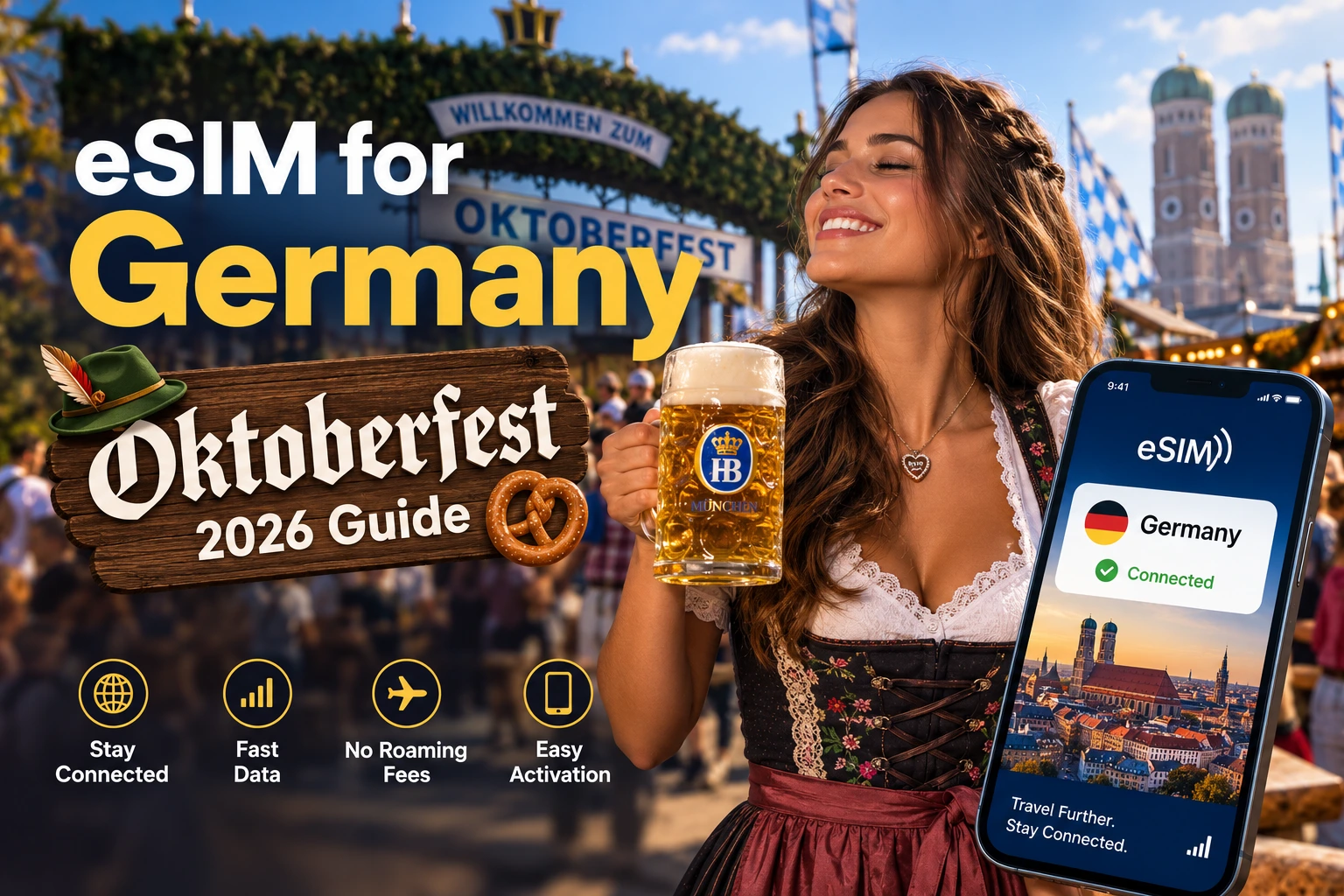
Guide to Best eSIMs and Oktoberfest Munich 2026
Six million people. Sixteen days. Fourteen large beer tents, each holding thousands, packed shoulder to shoulder from morning until late.
Oktoberfest is the largest folk festival in the world, and it creates a mobile network environment unlike almost anything else on earth. Every year, visitors discover the same thing at the same moment: they have full signal bars, they cannot load anything, and they have just lost their friends inside the Hofbräu-Festhalle.
This is the single most common Oktoberfest problem that nobody warns you about. It is worth solving before you arrive.
An eSIM for Germany gives you working mobile data from the moment you land at Munich Airport, with no roaming charges and no shop visit. More importantly for this particular trip, it lets you choose a provider whose performance in dense crowds has actually been tested.
This guide covers Oktoberfest 2026, running 19 September to 4 October: getting online, how much data you need, getting to the Theresienwiese, what really happens to mobile networks inside a beer tent, and how to not lose your group.
Why Oktoberfest Is the Hardest Test Your Phone Will Face
Let's be direct about the problem, because understanding it changes how you plan.
Mobile networks work by dividing capacity between the phones connected to a given cell tower. In normal conditions there is plenty to go around. At Oktoberfest, the Theresienwiese hosts hundreds of thousands of people in a space of about 34 hectares, all with phones, most of them filming, posting and calling at the same time.
The result is congestion rather than a coverage problem. Your phone shows a strong signal because the tower is close and the signal is strong. But the tower has no spare capacity to actually move your data. Messages sit unsent. Photos fail to upload. Maps refuse to refresh.
Germany's network operators deploy additional temporary capacity at the Wiesn every year specifically because of this, including mobile cell sites brought in for the festival. It helps. It does not eliminate the problem, particularly at peak evening hours in the tents.
Germany's telecoms regulator, the Bundesnetzagentur, monitors network coverage and quality nationally, and its reporting reflects the general pattern that measured mobile performance varies significantly between operators and drops under high load conditions. [Source: bundesnetzagentur.de]
So the practical question is not "will I have coverage". It is "whose network holds up when everyone else's does not".
Why This Is Where VIA eSIM's Testing Matters
Most eSIM providers publish coverage maps. Coverage maps tell you where a signal exists. They tell you nothing about whether that signal works when 5,000 people are standing in a tent with you.
VIA eSIM plans have been tested in some of the most demanding real-world conditions, including Old Trafford stadium with 75,000 people present, where data worked flawlessly, averaging 250 Mbps on 5G. That is a genuinely comparable scenario to an Oktoberfest tent, and arguably harder, since a stadium concentrates that many people into a much smaller footprint than the Theresienwiese.
We have also tested VIA eSIM across Germany. We recorded 420 Mbps on 5G at Marienplatz in central Munich during a busy weekend, 380 Mbps on 5G near the Brandenburg Gate in Berlin, and 340 Mbps on 4G at Neuschwanstein Castle with tour coaches arriving.
Coverage across Munich and Bavaria is strong, and the network capacity in the city centre is among the best in Germany.
Roaming to Germany: Where You Stand
If you are traveling from within the EU or EEA, you are covered. The EU Roam Like At Home rules mean your domestic allowance works in Germany at no extra cost. The European Commission's roaming framework applies across all EU and EEA member states. [Source: ec.europa.eu]
One caveat even for EU travelers. Most carriers apply a fair use policy, and once you exceed it your speeds are throttled sharply. At Oktoberfest, where you are already competing for congested capacity, being throttled on top of that makes a connection close to unusable. If your plan has a low fair use cap, a dedicated travel data plan is still worth considering.
If you are traveling from outside the EU, the picture is very different. Visitors from the UK, United States, Canada, Australia, the Balkans and the Gulf are on international roaming rates. Oktoberfest draws a huge international crowd and these travelers routinely come home to expensive bills after two weeks of heavy use.
A travel eSIM gives you a fixed cost and full speed for a known amount of data.
What an eSIM Is, in Plain Terms
An eSIM is a SIM card built into your phone as software rather than a physical chip. You buy a plan, receive a QR code, scan it, and your phone downloads the profile.
Your existing SIM stays in place. Your normal number keeps working for calls and texts. The eSIM handles data only.
For Germany specifically, there is a practical bonus. Buying a local German SIM requires identity verification under German law, which usually means presenting your passport and completing a registration process, sometimes including a video identification step. That is a slow errand to run on your first morning in Munich. An eSIM skips it entirely.
If you are still choosing between approaches, our comparison of whether an eSIM or physical SIM is right for you covers it properly.
Phone Compatibility
Most phones from recent years support eSIM:
- iPhone: XS, XR and everything newer
- Samsung Galaxy: S20 and newer, plus recent Z Fold and Z Flip models
- Google Pixel: Pixel 3 and newer
- Others: Many recent Sony, Motorola, Oppo, Xiaomi and Huawei models
Two checks. Your phone must be carrier unlocked. And if you travel regularly you may have old profiles stored, so it helps to know how many eSIMs you can have on one phone before adding another.
Install Before You Fly
Set up your eSIM at home on wifi before you travel. This is the tip that prevents the most problems.
Downloading an eSIM profile needs an internet connection. Munich Airport during Oktoberfest season is extremely busy, and its wifi is fine but not something you want to depend on while jetlagged.
The steps:
- Buy your plan and receive a QR code by email.
- Open phone settings, go to mobile or cellular data.
- Select add eSIM or add data plan.
- Scan the QR code.
- Name it clearly, like "Munich Oktoberfest".
- Leave it switched off until you land.
Most travel plans count days from first activation, not from purchase, so installing early costs nothing.
Switch it on when you land and you have data before you leave the terminal. Our walkthrough on how to set up your VIA eSIM has the full detail with screenshots.
How Much Data Do You Need?
Oktoberfest is one of the most photographed and filmed events in the world. People post constantly. Plan accordingly.
Activity Approximate data use Maps navigation 5 MB per hour WhatsApp messages and photos 10 MB per hour Instagram scrolling 100 MB per hour Uploading a 60 second video 50 to 100 MB Music streaming 80 MB per hour Video streaming, standard quality 700 MB per hour Video call home 300 MB per hour Live streaming to social 1 GB per hour That last row is the one that catches people. A single live stream from inside a tent can consume more data than a whole day of normal use.
Planning guidance:
- Long weekend, three to four days: 5 GB
- A week in Munich: 10 GB
- The full sixteen days, or heavy video: 20 GB or unlimited
Buy larger than you calculate. A single day at the Wiesn with filming and posting can use 2 GB comfortably.
Download offline maps for Munich before you travel, and download your music. Both save meaningful data.
Getting to the Theresienwiese
Oktoberfest takes place on the Theresienwiese, a large open ground southwest of Munich city centre. Locals call it the Wiesn, and you will hear the festival itself called that too.
From Munich Airport. The S1 and S8 S-Bahn lines run into the city centre and take around 40 minutes. The Lufthansa Express Bus is an alternative. Taxis are expensive for that distance.
By U-Bahn. Theresienwiese station on the U4 and U5 is the closest. Schwanthalerhöhe on the U4 and U5 and Goetheplatz on the U3 and U6 are good alternatives and are often far less crowded when leaving.
By S-Bahn. Hackerbrücke station is a common approach from the main station area.
On foot. The Wiesn is about a 20 minute walk from Hauptbahnhof, the central station. On busy days walking is genuinely faster than the U-Bahn.
Do not drive. Parking near the Wiesn is effectively nonexistent during the festival, and drink driving limits in Germany are strict and strictly enforced.
A serious practical note. Munich public transport is excellent but it is overwhelmed at closing time when the tents empty. Theresienwiese station in particular gets so crowded that entry is sometimes restricted for safety. Walking one stop to a quieter station is usually faster and much more comfortable.
Surviving the Tents: Practical Advice
This is the part that determines whether your day goes well.
Book a table if you can. Tent reservations open early in the year and go quickly, usually through the individual tents rather than a central system. Without a reservation you can still get in, but you need to arrive early. On weekends that means before 9am for the popular tents.
Weekdays are much easier. Monday to Thursday, particularly in the first week, is dramatically less crowded than any weekend.
You must have a seat to be served. This is the rule that surprises everyone. Beer is only served to people seated at a table. Standing around will not get you served.
Cash matters. Many tents are cash only or strongly prefer cash. Bring more than you think you need. ATM queues on site are long.
The beer is stronger than it looks. Oktoberfest beer is typically around 6 percent, and it is served in a one litre Maß. Pace yourself and eat.
Tipping. Round up generously for your server. They are working extremely hard and they will remember you.
How Not to Lose Your Group
Every single year, thousands of people get separated inside tents and cannot reconnect because the network is congested. Here is what actually works.
- Agree a physical meeting point before you go in. Not "by the entrance". Something specific, like a named tent's main entrance at a specific time.
- Agree a time as well as a place. "Here at 6pm" survives a dead phone. A message does not.
- Screenshot everything. Your table reservation, your hotel address, your return train time. Do not rely on loading them live.
- Share your live location before you go in, while you still have working data.
- Send messages, not calls. Text needs a fraction of the bandwidth and will often get through when a call will not.
- Carry a power bank. This is not optional. A full day of photos, video and searching for signal will empty a phone by mid-afternoon.
- Write your hotel address on paper. Genuinely. Phones die.
Sharing Your Connection
Hotspot and tethering let you share your data with your group. At Oktoberfest, where a group might have one person with a good travel plan and several on expensive roaming, this is worth setting up.
Turn on personal hotspot in your phone settings, set a password, and others connect as they would to wifi.
Two warnings that matter especially here. Hotspot drains battery fast, and battery is already your constraint at a full day event. And shared data disappears quickly if anyone starts uploading video. If you are the group hotspot, buy a bigger plan.
What Else to Do in Munich
Oktoberfest runs for over two weeks, and Munich is worth seeing beyond the Wiesn.
Marienplatz is the central square, with the Glockenspiel show in the New Town Hall at 11am and noon. Touristy, but worth seeing once.
The Englischer Garten is one of the largest urban parks in the world, bigger than Central Park. The surfers on the standing wave at the Eisbach are a genuine Munich oddity worth walking to.
Viktualienmarkt is the daily food market in the centre, good for lunch and better value than the Wiesn.
Museums. The Deutsches Museum is one of the largest science and technology museums anywhere. The Pinakothek galleries cover art from the old masters to modern.
Day trips. Neuschwanstein Castle is around two hours away. Salzburg is under two hours by train. Both are easy day trips and both are a good use of a recovery day.
Practical notes for Germany:
- Cash is used more than in most of western Europe. Many restaurants and bars are card-free or card-limited. Always carry some.
- Shops close on Sundays, almost without exception. Plan food shopping around it.
- Public transport runs on an honour system with ticket inspections. Validate your ticket. Fines are enforced without sympathy.
- Tap water is safe. Restaurants will usually serve bottled by default, so ask if you want tap.
- Late September weather in Munich swings widely. It can be 25 degrees or it can be 8 degrees and raining. Bring layers.
Frequently Asked Questions
Q: Will my data actually work inside an Oktoberfest tent? A: Performance in dense crowds depends heavily on network capacity. VIA eSIM has been tested at Old Trafford with 75,000 people present, averaging 250 Mbps on 5G, which is a comparable load. That said, no provider can guarantee perfect performance when hundreds of thousands of people are online in one place. Plan around it: agree meeting points, screenshot what you need, and carry a power bank.
Q: I'm traveling from the EU. Do I need a travel eSIM? A: Not strictly, since EU roaming rules cover Germany. It is still worth checking your fair use cap. If you exceed it your speeds get throttled, and at Oktoberfest that combines badly with congestion.
Q: Can I keep my normal number? A: Yes. Your physical SIM stays active for calls and texts. The eSIM handles data only.
Q: Do I need my passport to get an eSIM? A: No. German law requires identity verification for local SIM cards, but a travel eSIM needs no paperwork.
Q: How much data for the full festival? A: If you are staying the whole sixteen days and posting regularly, 20 GB or an unlimited plan is realistic. For a long weekend, 5 GB is usually enough.
Final Thoughts
Oktoberfest is worth doing properly. Six million people, sixteen days, and a city that handles it with more competence than any other place could manage.
The connectivity part is where most visitors get caught out, and it is entirely preventable. Set up an eSIM for Germany at home before you fly, activate it when you land, and you have working data from the airport to the tent and back.
Plan for 5 GB over a long weekend and 20 GB if you are staying for the run of the festival. Agree your meeting points out loud before you go into a tent. Screenshot your reservation. Carry cash and carry a power bank.
VIA eSIM plans are tested in exactly the conditions Oktoberfest creates, at capacity venues with tens of thousands of people, so the connection holds when everyone else's is struggling. Take a look at the Germany plans and get set up before you travel.
Sources
- Bundesnetzagentur, German Federal Network Agency, mobile network coverage and quality monitoring. https://www.bundesnetzagentur.de/EN/Home/home_node.html
- European Commission, Roaming regulation and Roam Like At Home rules for EU and EEA travelers. https://ec.europa.eu/digital-single-market/en/roaming