
How eSIM Data Plans Work: Local vs Regional vs Global Explained
Choosing the right eSIM data plan can make a big difference when traveling. While eSIM technology removes the need for physical SIM cards, many travelers still struggle to understand the difference between local, regional, and global eSIM plans.
This guide explains how eSIM data plans work, compares each type, and helps you choose the best eSIM plan for your trip.
What Is an eSIM Data Plan?
An eSIM data plan is a digital mobile data package that lets your phone connect to cellular networks without a physical SIM card. Instead of inserting a SIM, you activate the plan by scanning a QR code or downloading it directly to your device.
eSIM plans are popular among travelers because they are:
- Instant to install
- Easy to switch between plans
- Compatible with multiple countries
- Ideal for international travel connectivity
How eSIM Data Plans Connect to Networks
eSIM providers partner with local mobile carriers worldwide. When you arrive in a destination, your device automatically connects to a supported partner network.
Most travel eSIM plans operate through secure roaming agreements, which is why data roaming must be enabled for the eSIM to function properly.
Local eSIM Plans
What Is a Local eSIM Plan?
A local eSIM plan is a data plan that works only in one specific country.
Best For
- Single-country trips
- Short vacations
- Travelers who want maximum local speed
Advantages
- Usually the cheapest option
- Strong local signal quality
- Reliable speeds
Limitations
- Stops working once you leave the country
- Requires a new plan for the next destination
Example:
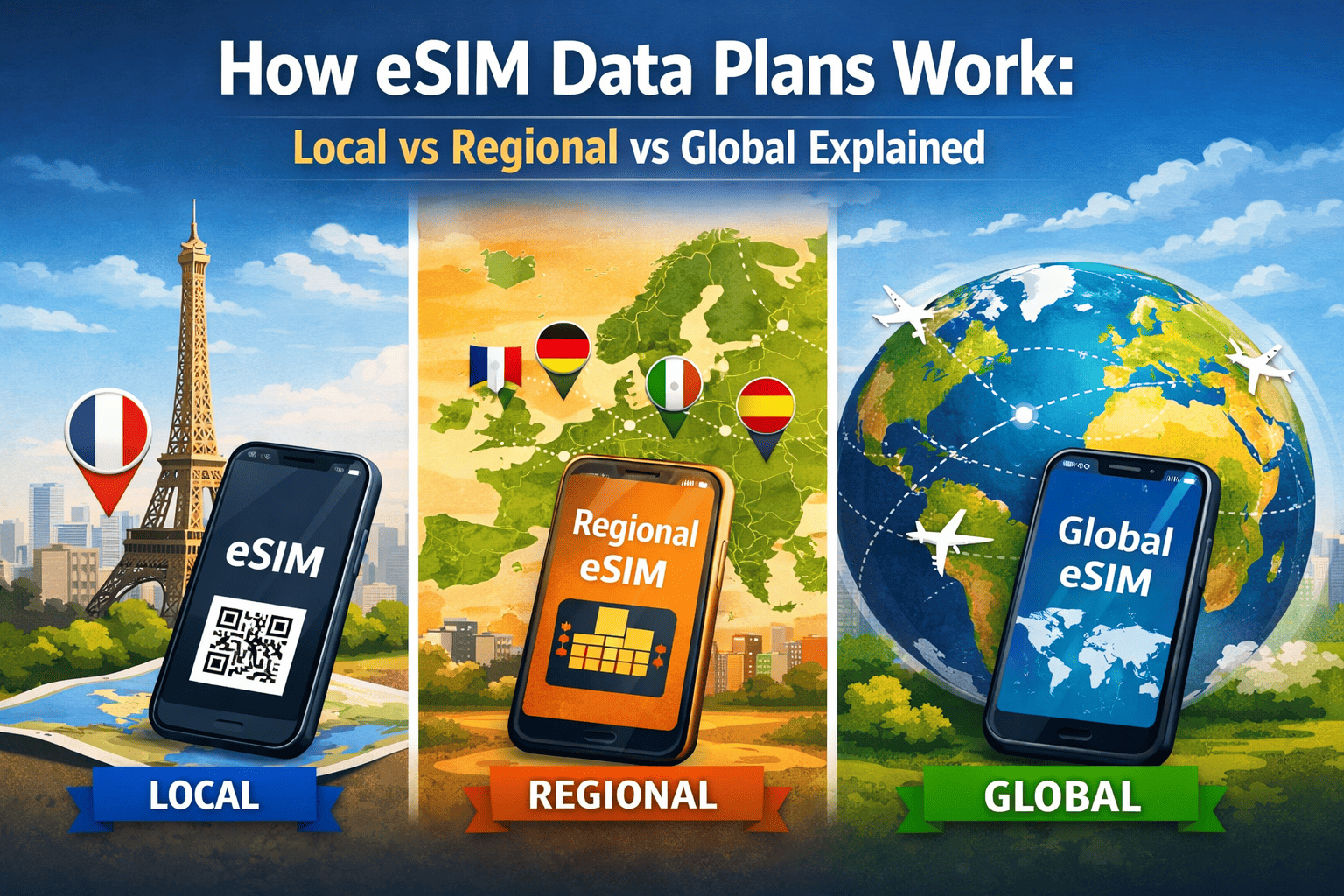
A France eSIM plan only works within France.
Regional eSIM Plans
What Is a Regional eSIM Plan?
A regional eSIM plan provides data coverage across multiple countries within one region such as Europe, Asia, or North America.
Best For
- Multi-country trips
- Backpacking across borders
- Business travel
Advantages
- One plan works in several countries
- No reinstall needed when crossing borders
- More convenient than buying multiple plans
Limitations
- Slightly more expensive than local plans
- Network quality may vary between countries
Example:
A Europe eSIM may work in France, Germany, Italy, and Spain under one plan.
Global eSIM Plans
What Is a Global eSIM Plan?
A global eSIM plan is a data plan that works across dozens or even hundreds of countries worldwide.
Best For
- Frequent travelers
- Long-term international trips
- Remote workers abroad
Advantages
- Worldwide coverage
- One eSIM usable for multiple trips
- Maximum flexibility
Limitations
- Higher price per GB
- Speeds can vary depending on location
Local vs Regional vs Global eSIM — Key Differences
Coverage
- Local → one country
- Regional → several countries in one region
- Global → worldwide coverage
Cost
- Local → lowest price
- Regional → medium price
- Global → highest cost per GB
Convenience
- Local → best for single destination
- Regional → best for multi-country trips
- Global → best for frequent international travel
Which eSIM Plan Should You Choose?
Ask yourself these questions:
- Are you visiting one country or multiple?
- How long is your trip?
- Do you need flexibility between destinations?
Quick Guide
- One country → choose local plan
- Several nearby countries → choose regional plan
- Multiple continents → choose global plan
Choosing the right option ensures you avoid roaming fees while staying connected abroad.
Common Mistakes When Choosing an eSIM
Avoid these frequent traveler mistakes:
- Buying a local plan for multi-country travel
- Activating the eSIM too early
- Forgetting to enable roaming
- Not checking phone compatibility
Avoiding these mistakes ensures stable connectivity during your trip.
FAQ — eSIM Data Plans
Can you switch between eSIM plans while traveling?
Yes. Most smartphones allow you to install multiple eSIM profiles and switch between them anytime.
Do eSIM plans include calls or SMS?
Most travel eSIM plans are data-only. Calls can be made through apps like WhatsApp.
Can an eSIM work together with a physical SIM?
Yes. Many devices support dual SIM functionality, allowing one physical SIM and one eSIM.
Is eSIM faster than international roaming?
Often yes. Travel eSIMs usually connect directly to local networks, which can provide faster speeds and lower latency than traditional roaming.
Final Thoughts
Understanding the difference between local, regional, and global eSIM plans helps you choose the right solution for your travel needs. The best plan depends on your destination, travel duration, and coverage requirements.
Using a reliable provider like Via eSIM can simplify the process, helping travelers stay connected worldwide without expensive roaming charges or complicated SIM swaps.