

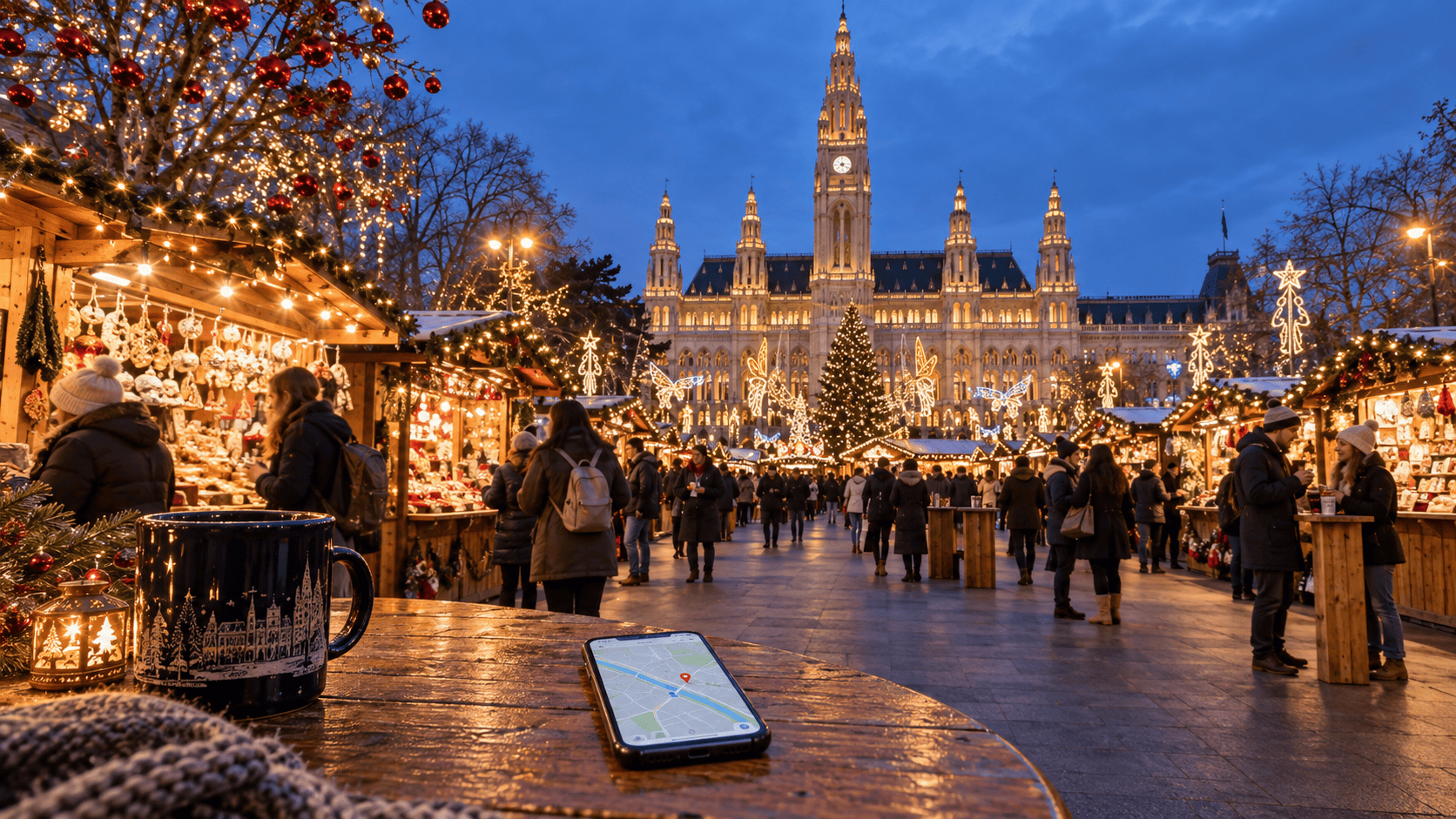
Vienna Christmas Market 2026: Dates, Locations & Travel Guide
Vienna is one of Europe’s leading Christmas market destinations, with festive events held in front of the City Hall, imperial palaces, historic squares and small neighborhood streets. Each market offers a different atmosphere, opening schedule and selection of seasonal food, crafts and activities.
The main Viennese Christmas Market at Rathausplatz combines traditional stalls, family attractions and ice skating in the center of the city. Other confirmed options for 2026 include Schönbrunn Palace, Stephansplatz, Spittelberg, Karlsplatz and the Old Viennese Christmas Market at Freyung.
This guide covers the confirmed Vienna Christmas market dates for 2026, the best markets to visit, opening hours, transportation, expected costs and practical advice for planning your trip. Vienna is also our best overall choice in this guide to the best Christmas markets in Europe for 2026.
Vienna Christmas Market 2026: Quick Answer
Vienna’s main Christmas market at Rathausplatz will run from November 13 to December 26, 2026. It will be open daily from 10:00 am until 10:00 pm, with reduced hours on December 24.
Vienna has several Christmas markets, and each follows its own schedule. The Christmas Market at Schönbrunn Palace opens on November 6, 2026 and continues until January 6, 2027, making it one of the best options for visitors traveling after Christmas.
Stephansplatz also opens on November 6, while Spittelberg, Karlsplatz and several other markets begin in the middle of November. Many of the smaller traditional markets close on December 23.
For a first visit, plan at least two full days. This provides enough time to experience Rathausplatz, Schönbrunn Palace and two or three smaller markets without rushing between locations.
Vienna Christmas Market 2026 Dates
Vienna’s Christmas markets do not share one opening and closing date. Some begin during the first week of November, while others open in the middle of the month and close shortly before Christmas.
The principal confirmed dates for 2026 are:
- Viennese Christmas Market at Rathausplatz: November 13 to December 26, 2026
- Christmas Market at Schönbrunn Palace: November 6, 2026 to January 6, 2027
- Christmas Village at Maria-Theresien-Platz: November 20 to December 26, 2026
- Old Viennese Christmas Market at Freyung: November 14 to December 23, 2026
- Christmas Market at Am Hof: November 13 to December 23, 2026
- Christmas Village at Stephansplatz: November 6 to December 26, 2026
- Art Advent at Karlsplatz: November 13 to December 23, 2026
- Christmas Market at Spittelberg: November 13 to December 23, 2026
- Winter Market at Riesenradplatz: November 20, 2026 to January 6, 2027
Opening hours also vary by location. Rathausplatz operates daily from 10:00 am to 10:00 pm, while smaller craft-focused markets generally close between 8:00 pm and 9:30 pm. Several locations have reduced hours on December 24.
The complete list of confirmed dates, addresses and holiday opening hours is available through the official Vienna Christmas market schedule. Visitors should check the schedule again shortly before traveling because individual opening hours may change.
Is the Vienna Christmas Market Open After Christmas?
Yes, some Vienna Christmas markets remain open after December 25, but many traditional Advent markets close on December 23.
The main market at Rathausplatz and the Christmas Village at Stephansplatz continue until December 26. Schönbrunn Palace and the Winter Market at Riesenradplatz remain open until January 6, 2027.
The Vienna Ice World at Rathausplatz also continues until January 6, although it is closed on December 31. Visitors traveling between Christmas and New Year should therefore focus on Schönbrunn Palace, Riesenradplatz and the remaining seasonal attractions rather than expecting every Advent market to remain open.
Opening hours are normally reduced on December 24, 25 and 26, so each location should be checked separately before visiting.
Best Christmas Markets in Vienna
Vienna has Christmas markets across the city, ranging from the large celebration at Rathausplatz to smaller craft markets in historic streets and squares. The best choice depends on whether you prefer family activities, an imperial setting, traditional handicrafts or a quieter local atmosphere.
Vienna Christmas Market at Rathausplatz
Best for: First-time visitors, families and the largest festive experience
2026 dates: November 13 to December 26, 2026
The Viennese Christmas Market at Rathausplatz is the city’s main and most recognizable Christmas market. It takes place in front of Vienna City Hall and combines decorated stalls with seasonal food, hot drinks, lights and activities for children.
Rathausplatz is the best starting point for first-time visitors because it provides the large, classic Christmas market experience associated with Vienna. Its central location also makes it easy to combine with nearby attractions and other markets in the historic center.
The Vienna Ice World operates alongside the market and continues until January 6, 2027. This makes Rathausplatz particularly suitable for families and visitors who want more than shopping and food.
The market is open daily from 10:00 am to 10:00 pm, with reduced hours on December 24. Friday evenings and weekends are normally the busiest periods, so weekday afternoons provide a more comfortable experience.
Schönbrunn Palace Christmas Market
Best for: An imperial setting, families and visits after Christmas
2026 dates: November 6, 2026 to January 6, 2027
The Christmas Market at Schönbrunn Palace is held in the forecourt of one of Vienna’s most famous imperial landmarks. The illuminated palace provides a more spacious and elegant setting than the markets located in the city center.
Decorated stalls offer traditional handicrafts, Christmas decorations, gifts and regional Austrian food. The market also includes seasonal experiences for families, making it suitable for both adults and children.
Schönbrunn is one of the earliest Vienna Christmas markets to open and one of the few that remains active until January 6. It is therefore the strongest option for travelers arriving after December 25.
The market is located outside the central Old Town but is easily reached by public transportation. Visitors should allow at least half a day if they also plan to tour Schönbrunn Palace or its grounds.
Christmas Village at Stephansplatz
Best for: A central location, sightseeing and a shorter visit
2026 dates: November 6 to December 26, 2026
The Christmas Village at Stephansplatz is located beside St. Stephen’s Cathedral in the heart of Vienna. Its position makes it one of the easiest markets to include in a sightseeing itinerary through the historic center.
Around 40 stalls focus on Austrian products, handicrafts, food and seasonal gifts. The market is smaller than Rathausplatz, so it can usually be explored in less time.
Stephansplatz is particularly convenient for visitors who want to combine a Christmas market with Graben, Kärntner Straße, the Hofburg area and Vienna’s central shopping streets.
The market remains open on December 25 and 26 with reduced hours, making it another option for travelers visiting immediately after Christmas.
Spittelberg Christmas Market
Best for: Small streets, local products and a neighborhood atmosphere
2026 dates: November 13 to December 23, 2026
The Spittelberg Christmas Market is spread through the narrow streets of Vienna’s historic Biedermeier district. Instead of occupying one large square, its stalls are placed along Spittelberggasse, Stiftgasse, Schrankgasse and Gutenberggasse.
Spittelberg places greater emphasis on handicrafts, sustainable products, local goods, fair-trade items and organic food. Its small streets and historic buildings create a more intimate atmosphere than the large central markets.
This market is a strong choice for couples and visitors who want to explore a neighborhood rather than remain around Vienna’s largest tourist attractions. It is also close to the MuseumsQuartier and can be combined with Rathausplatz during the same afternoon or evening.
The streets become crowded during weekend evenings. Weekday visits are more comfortable, particularly shortly after the market opens at 2:00 pm.
Art Advent at Karlsplatz
Best for: Arts, crafts, organic food and creative products
2026 dates: November 13 to December 23, 2026
Art Advent takes place at Karlsplatz in front of the Karlskirche. The market focuses on arts and crafts, with participating sellers offering products that follow the event’s quality and design requirements.
Visitors can also find art installations, live workshops, music and activities for children. Food sold at the market is organically certified, which distinguishes Karlsplatz from many of Vienna’s larger Christmas markets.
Karlsplatz is particularly suitable for visitors looking for handmade gifts rather than mass-produced souvenirs. Its open setting in front of the church also provides more space than the narrow streets of Spittelberg.
The market operates daily from 12:00 pm to 8:00 pm, with food available until 9:00 pm. It is easily reached using Vienna’s public transportation system.
Old Viennese Christmas Market at Freyung
Best for: Traditional crafts, history and a quieter central market
2026 dates: November 14 to December 23, 2026
The Old Viennese Christmas Market at Freyung is one of Vienna’s most traditional seasonal markets. A Christmas market was held in this square as early as 1772, giving the location a long historical connection to Advent trading.
Stalls offer handicrafts, glass decorations, ceramics, traditional nativity items and seasonal food. Advent music is also performed in the square during the market period.
Freyung is smaller and generally calmer than Rathausplatz. It is well suited to visitors interested in traditional products and a compact market that can be explored without spending several hours.
The market is located in the city center and can easily be combined with Am Hof, the Hofburg and Vienna’s historic shopping streets. It operates daily from 10:00 am to 9:00 pm.
Which Vienna Christmas Market Should You Visit?
The best Vienna Christmas market depends on the type of experience you want. Rathausplatz is the strongest all-round option, while Schönbrunn Palace, Spittelberg, Karlsplatz and Freyung are better suited to more specific interests.
Best for First-Time Visitors
The Viennese Christmas Market at Rathausplatz is the best choice for first-time visitors. It provides the city’s largest and most complete festive experience, with decorated stalls, seasonal food, family activities and ice skating in front of Vienna City Hall.
Its central location also makes it easy to combine with the historic center, the Hofburg and other nearby Christmas markets. Visitors with limited time should begin at Rathausplatz and add one smaller market later in the day.
Best for Families
Rathausplatz is the most convenient option for families because it combines a traditional Christmas market with children’s activities and the Vienna Ice World.
Schönbrunn Palace is another strong choice for families who prefer a more spacious setting and want to combine the market with the palace grounds or other nearby attractions. It is also a better option for trips taking place after Christmas.
Best for Traditional Crafts
The Old Viennese Christmas Market at Freyung is the best choice for traditional decorations, ceramics, glass items and products connected to Austrian Advent culture.
Visitors looking for contemporary handmade products should also consider Art Advent at Karlsplatz. This market places greater emphasis on original arts and crafts and applies quality requirements to participating sellers.
Best for a Romantic Atmosphere
Spittelberg is the best Vienna Christmas market for couples and visitors looking for a more intimate atmosphere. Its stalls are distributed through narrow historic streets instead of one large public square.
The surrounding Biedermeier buildings, smaller stalls and neighborhood setting make it particularly atmospheric after dark. Weekday evenings are preferable because the streets become crowded during weekends.
Best Market After Christmas
The Christmas Market at Schönbrunn Palace is the best option after Christmas because it remains open until January 6, 2027.
The Winter Market at Riesenradplatz also continues until January 6 and offers more entertainment, food and evening activity. Rathausplatz and Stephansplatz remain open only until December 26, while most smaller Advent markets close on December 23.
When Is the Best Time to Visit Vienna’s Christmas Markets?
Early December is the best time for most visitors. By this point, all major Christmas markets are open, the complete festive program has started and the city’s Christmas lights are fully in place.
Late November is better for travelers who prioritize smaller crowds and potentially lower accommodation prices. However, some markets and scheduled activities may only begin during the final weeks of November.
Mid-December provides the strongest Christmas atmosphere but also brings larger crowds, particularly during Friday evenings and weekends. The final weekend before Christmas is normally the busiest period.
Best Dates for Fewer Crowds
For fewer crowds, visit between Monday and Thursday during late November or the first half of December.
Weekday mornings and early afternoons are generally quieter than evenings. Rathausplatz, Schönbrunn Palace and Spittelberg become particularly busy after work hours and throughout the weekend.
Travelers who want to visit several markets should avoid scheduling the entire trip around a Saturday. Use the weekend for museums, palace visits or smaller markets, then visit the most popular locations on a weekday.
The period immediately after Christmas is quieter, but the selection is limited because many traditional markets close on December 23 or 26.
Best Time of Day to Visit
The best time to arrive is between 3:00 pm and 4:00 pm. This allows you to explore the stalls before the evening crowds arrive and remain long enough to see the lights after dark.
Morning visits are better for shopping, photography and exploring the markets at a relaxed pace. However, the festive atmosphere becomes stronger in the evening when the lights are visible and more visitors gather for food and seasonal drinks.
A practical approach is to visit one large market during the afternoon and a smaller market after dark. For example, you can explore Schönbrunn Palace earlier in the day and visit Spittelberg or Rathausplatz in the evening.
How Many Days Do You Need for Vienna’s Christmas Markets?
Two full days are enough for most visitors to experience Vienna’s principal Christmas markets without rushing. Three days are better if you also want to visit Schönbrunn Palace, museums and other major attractions.
With only one day, focus on three or four locations rather than attempting to visit every market. A practical route begins at Schönbrunn Palace, continues through Karlsplatz and Stephansplatz, and finishes at Rathausplatz after dark.
For a two-day trip, divide the markets by area:
- Day one: Stephansplatz, Freyung, Am Hof and Rathausplatz
- Day two: Schönbrunn Palace, Karlsplatz and Spittelberg
A third day provides time for palace interiors, museums, cafés and smaller markets without organizing the entire trip around a strict schedule. It also gives you flexibility if the weather is poor during one of the evenings.
Visitors planning to combine Vienna with Salzburg, Budapest or Prague should still allocate at least two nights to Vienna. Arriving late and leaving the following morning does not provide enough time to experience the markets after dark.
How to Get Around Vienna’s Christmas Markets
Public transportation is the most convenient way to travel between Vienna’s Christmas markets. The underground, trams and buses connect the central markets with Schönbrunn Palace and other locations outside the historic center.
Stephansplatz, Freyung, Am Hof and Rathausplatz are located relatively close to one another and can be combined on foot. Walking between these markets also allows you to see Vienna’s decorated streets, shopping areas and historic buildings.
Schönbrunn Palace is farther from the city center and should be reached by underground or tram. Spittelberg is close to the MuseumsQuartier, while Karlsplatz is connected to several central transportation routes.
Travelers visiting several locations in one day should compare Vienna’s short-term public transportation passes with the cost of purchasing individual tickets. Available ticket types and conditions should be checked through the official Wiener Linien website.
Driving is unnecessary for most Christmas market itineraries. Parking in central Vienna can be limited and expensive, while several market areas are easier to reach by public transportation or on foot.
Allow additional travel time during Friday evenings and weekends because trains, trams and central stations may be busier than usual. Saving market addresses and transportation routes before leaving your accommodation can also make it easier to move between locations.
What to Eat and Drink at Vienna Christmas Markets
Vienna’s Christmas markets offer a mixture of Austrian seasonal food, sweets and hot drinks. The available selection differs by market, but several items appear across most major locations.
Glühwein is one of the most common drinks. It is made with heated red or white wine, sugar and spices such as cinnamon, cloves and star anise. Markets also serve different varieties of fruit punch and non-alcoholic Kinderpunsch.
Hot drinks are often served in reusable market mugs. Visitors normally pay a deposit in addition to the price of the drink. The mug can be returned to recover the deposit or kept as a souvenir. Prices and deposit amounts vary between markets.
Popular food and sweets to look for include:
- Vanillekipferl: Small crescent-shaped cookies made with nuts, butter and vanilla sugar
- Lebkuchen: Spiced gingerbread sold in different shapes and sizes
- Roasted chestnuts: A simple winter snack known locally as Maroni
- Roasted almonds: Often prepared with sugar and seasonal spices
- Austrian sausages: Served with bread, mustard or other toppings
- Baked potatoes and warm soups: Practical options during colder evenings
- Kaiserschmarrn: Pieces of shredded pancake commonly served with powdered sugar and fruit compote
- Stollen: A traditional Christmas bread containing dried fruit and sugar
Rathausplatz provides the widest food selection, while Karlsplatz emphasizes organically certified food. Schönbrunn Palace is a strong choice for visitors who want regional products in a more spacious setting.
Food stalls at the largest markets become busy during the evening. Visiting before 5:00 pm usually means shorter lines and more available standing space.
What to Buy at Vienna Christmas Markets
The best products to buy at Vienna’s Christmas markets are handmade decorations, ceramics, glass items, candles, textiles and small gifts connected to Austrian Christmas traditions.
Freyung is particularly suitable for traditional handicrafts, glass decorations, ceramics and nativity items. Karlsplatz is better for original art and contemporary handmade products, while Spittelberg offers a mixture of local, sustainable, fair-trade and organic goods.
Popular Christmas market purchases include:
- Handmade Christmas tree decorations
- Wooden ornaments and nativity figures
- Ceramics, cups and serving dishes
- Decorative glass items
- Candles and seasonal home decorations
- Wool products, scarves and other winter accessories
- Packaged cookies, chocolate and regional food products
- Vienna-themed snow globes
The snow globe was invented in Vienna, and versions featuring St. Stephen’s Cathedral, Schönbrunn Palace and the Giant Ferris Wheel are available across the city.
Visitors looking for authentic crafts should compare several stalls before buying. Product quality and origin can vary, particularly at the largest markets. Karlsplatz, Freyung and Spittelberg are generally stronger choices for travelers prioritizing handmade products over standard souvenirs.
Fragile decorations and glass items should be packed carefully for the return journey. Travelers flying with limited luggage should prioritize smaller ornaments, packaged sweets or textiles that are easier to transport.
How Much Should You Budget?
Most Vienna Christmas markets are free to enter, but food, drinks, shopping, transportation and paid attractions should be budgeted separately.
For one market visit, a reasonable food and drink budget is approximately €25 to €50 per person. This can cover one main food item, a hot drink and one or two snacks. Visitors buying several drinks, desserts or full meals may spend more.
Typical planning ranges include:
- Hot drinks: Approximately €5 to €8, excluding any refundable mug deposit
- Snacks and sweets: Approximately €4 to €9
- Main food items: Approximately €8 to €15
- Small souvenirs: Approximately €10 to €30
- Handmade gifts: From approximately €20, depending on the product
- Public transportation: Approximately €10 to €20 per day, depending on the ticket selected
These are planning estimates rather than fixed prices. Each market sets its own prices, and handmade products, ticketed activities and restaurant meals can increase the total considerably.
A budget traveler should allow approximately €70 to €120 per day, excluding accommodation. A mid-range traveler using public transportation, eating at the markets and visiting paid attractions may spend approximately €130 to €220 per day, excluding the hotel.
Accommodation is normally the largest expense. Central hotels become more expensive during December weekends, so booking several months in advance or staying outside the historic center can reduce the overall cost.
How to Stay Connected in Vienna
Mobile data is useful in Vienna for public transportation routes, digital tickets, walking directions, restaurant reservations and checking last-minute changes to Christmas market opening hours.
Free Wi-Fi is available in some hotels, cafés and public areas, but it should not be the only connection option when moving between markets. Crowded locations may have slower or less reliable public networks.
Travelers staying primarily in Austria can compare an Austria eSIM from VIA eSIM before departure. An eSIM allows compatible phones to connect to mobile data without replacing the primary physical SIM card.
Install the eSIM while you have reliable Wi-Fi and select it as the mobile data line after arriving. Data Roaming may need to be enabled on the travel eSIM so that it can connect to its supported partner network. Keep Data Roaming turned off on your primary SIM if your home plan does not include international usage.
This guide explains when Data Roaming should be enabled on a travel eSIM and how to prevent your primary line from using roaming data.
For a short Vienna trip focused on navigation, messaging and occasional browsing, a small data package may be sufficient. Travelers using social media, video, hotspot sharing or several travel apps should choose a larger allowance. You can estimate your requirements with this guide to how much mobile data you may need for travel.
Download important tickets, hotel details and offline maps before leaving your accommodation. This provides a backup if your phone temporarily loses coverage or runs out of data.
Can You Combine Vienna With Other Christmas Markets?
Yes. Vienna is well connected by train, making it a practical stop on a multi-city Christmas market trip through Central Europe. Salzburg, Budapest and Prague can all be reached without flying, while the main railway stations in each city are connected to local public transport.
Book long-distance tickets early when possible, especially for December weekends, and check the official timetable shortly before departure because schedules may change.
Vienna and Salzburg
Vienna and Salzburg work well together if you want to combine large city markets with a smaller Alpine setting. Direct trains normally connect the cities twice per hour, with the fastest journeys taking approximately two and a half hours.
Spend at least two days in Vienna and one or two days in Salzburg. This gives you enough time to explore Vienna’s main markets before visiting Salzburg’s historic center, Cathedral Square and Mirabell Square.
You can check current departures and book tickets through the official ÖBB Vienna to Salzburg route page.
Vienna and Budapest
Budapest is one of the easiest international Christmas market destinations to combine with Vienna. Direct trains operate regularly between the two capitals, with the fastest journeys taking around two hours and 20 minutes.
A four-day itinerary can include two days in Vienna and two days in Budapest. In Budapest, the markets at Vörösmarty Square and St. Stephen’s Basilica are both centrally located and can be explored alongside the city’s thermal baths and Danube landmarks.
The latest connections are available through the official ÖBB Vienna to Budapest route page.
Vienna, Prague and Budapest
Vienna, Prague and Budapest form one of the most practical multi-country Christmas market routes in Europe. A sensible itinerary is:
- Prague: two or three nights
- Vienna: two or three nights
- Budapest: two nights
Traveling from Prague to Vienna and then continuing to Budapest avoids unnecessary backtracking. Direct trains between Prague and Vienna take approximately four hours, while the fastest Vienna to Budapest services take around two hours and 20 minutes.
Allow seven to nine days for the complete route. A shorter trip is possible, but spending at least two nights in each city makes the journey feel less rushed and leaves time for attractions beyond the markets.
Because this itinerary crosses the Czech Republic, Austria and Hungary, a regional Europe eSIM can be more convenient than arranging separate mobile data plans for every destination. It allows travelers to use maps, access train tickets and stay connected while crossing borders, subject to the countries and validity period included in the selected plan.
Before traveling, verify departure times through the official railway operators and reserve seats where available, particularly on popular December services.
If Prague is part of your route, use our Prague Christmas Market 2026 guide to plan which markets to visit and check their opening dates.
Frequently Asked Questions
Are Vienna Christmas Markets Free to Enter?
Yes. Vienna’s main outdoor Christmas markets are free to enter. You only pay for food, drinks, souvenirs and optional activities such as ice skating, rides or workshops.
Special attractions located near a market may require a separate ticket. For example, visiting the Christmas market outside Schönbrunn Palace is free, but entering the palace requires a paid admission ticket.
Do You Need Tickets for Vienna Christmas Markets?
No. You do not normally need a ticket or reservation to visit Vienna’s Christmas markets. Visitors can enter the markets freely during their published opening hours.
Tickets may be required for separate activities, including palace tours, concerts, workshops and some seasonal attractions. If you are planning a specific activity, check its official website before visiting.
Which Is the Main Christmas Market in Vienna?
The Vienna Christmas Market at Rathausplatz is generally considered the city’s main Christmas market. It is located in front of Vienna City Hall and combines a large number of stalls with festive lights, seasonal food and the Vienna Ice World.
Rathausplatz is the best starting point for first-time visitors, but smaller markets such as Spittelberg, Freyung and Karlsplatz can offer a quieter or more traditional atmosphere.
Are Vienna Christmas Markets Open on Christmas Day?
Some Vienna Christmas markets are open on Christmas Day, but many smaller Advent markets close by December 23.
According to the official 2026 schedule, the Christmas Market at Rathausplatz is open on December 25 and 26 from 10:00 am to 10:00 pm. The markets at Schönbrunn Palace and Stephansplatz also remain open, although they operate with reduced hours after December 24.
Always check the official schedule for the specific market you want to visit because opening hours can change.
Does It Snow in Vienna in December?
Snow is possible in Vienna during December, but it is not guaranteed. Winter temperatures are often close to freezing, yet Vienna generally receives less snow than many Alpine areas of Austria.
Travelers should plan for cold weather, rain or light snow rather than expecting consistently snowy Christmas markets. Warm layers, waterproof footwear, gloves and a hat are more important than relying on a particular forecast far in advance.
Is Vienna Expensive During the Christmas Market Season?
Vienna can be relatively expensive in December because accommodation demand increases during the Christmas market season. Hotels and popular train connections may cost more, especially on weekends and close to Christmas.
However, visiting the markets themselves is generally free. Travelers can control their daily spending by booking accommodation early, using public transport, eating away from the most crowded squares and setting a separate budget for drinks, food and souvenirs.
Is Vienna’s Christmas Market Suitable for Children?
Yes. Several Vienna Christmas markets are suitable for families with children. Rathausplatz is particularly popular because it combines festive decorations with seasonal activities and ice skating, while Schönbrunn offers a spacious setting outside the palace.
Families should visit earlier in the day when the markets are usually less crowded. Evening visits can be visually impressive, but narrow paths and busy food areas may be more difficult to navigate with young children or strollers.